Why Low-Carb Fatigue Fades After the First Week (If It's Going to at All)
Quick Answer: Initial low-carb fatigue is largely driven by electrolyte shifts and your body’s temporary adjustment from primarily burning glucose to burning fat for fuel, and it typically resolves within 5-10 days as that metabolic shift completes — persistent fatigue beyond two weeks usually means an intake or electrolyte issue, not a normal adjustment.
The first week of a lower-carb diet often comes with real fatigue, and understanding why makes it easier to push through the temporary part and catch the parts that aren’t temporary.

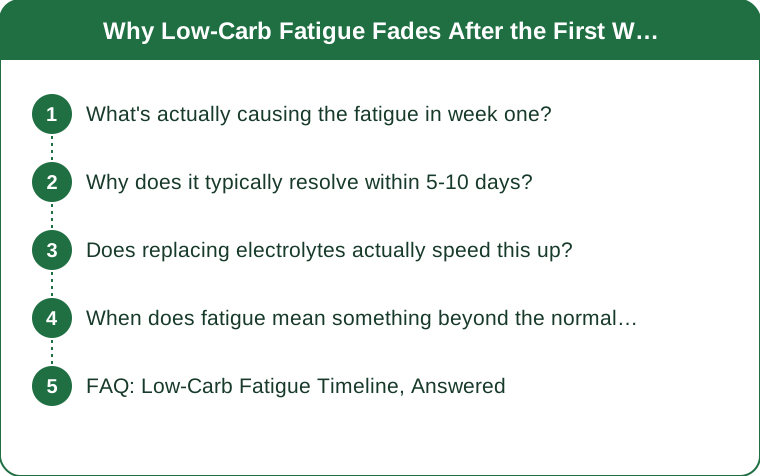
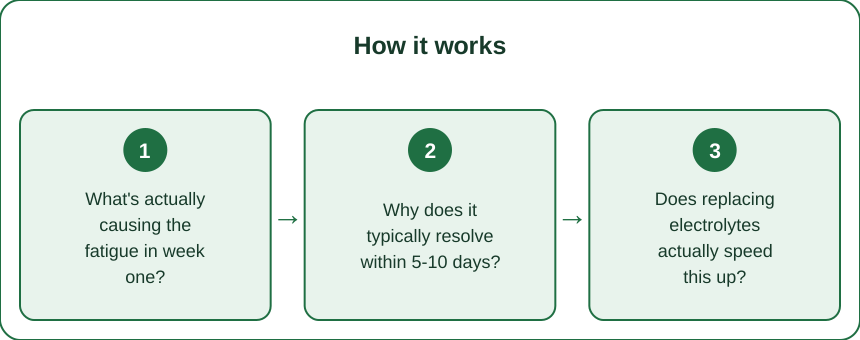
What’s actually causing the fatigue in week one?
Cutting carbs significantly reduces glycogen stores and triggers water and sodium loss, since glycogen is stored bound to water. This shift, combined with your body’s metabolism recalibrating toward burning fat for fuel, produces real, temporary fatigue that’s physiological, not just psychological adjustment.
Why does it typically resolve within 5-10 days?
Your body genuinely adapts its enzymatic and metabolic pathways to become more efficient at fat oxidation over roughly this timeframe, a process sometimes called keto-adaptation even for moderate low-carb (not just strict keto) approaches. Once that shift completes, energy levels for most people return to baseline or better.

Does replacing electrolytes actually speed this up?
Yes, meaningfully — since much of the fatigue relates to sodium, potassium, and magnesium loss alongside water, deliberately replacing these (through broth, electrolyte supplements, or mineral-rich foods) often measurably reduces the severity and duration of the initial fatigue window.
When does fatigue mean something beyond the normal adjustment?
Fatigue persisting past two weeks, or that’s severe enough to disrupt normal function, usually points to insufficient total calorie intake, inadequate electrolyte replacement, or that a low-carb approach simply isn’t the right metabolic fit for your body — all worth addressing directly rather than pushing through indefinitely.
FAQ: Low-Carb Fatigue Timeline, Answered
Does exercise make the first-week fatigue worse or better?
Light to moderate activity is generally fine and doesn’t worsen the adjustment; very intense training during week one may feel notably harder and is reasonable to scale back temporarily.
Should I add back some carbs if fatigue is severe?
A moderate approach with some carbs during the transition can ease the adjustment for some people, rather than an abrupt full cut.
Is the fatigue different for keto specifically versus a more moderate low-carb approach?
Stricter keto typically produces a more pronounced initial adjustment than a moderate carb reduction, simply due to the more dramatic scale of the metabolic shift involved.
TL;DR:
- Initial fatigue comes from glycogen and water/electrolyte loss plus a real metabolic adjustment
- Most people see it resolve within 5-10 days as fat-burning efficiency improves
- Deliberately replacing sodium, potassium, and magnesium meaningfully eases the transition
- Fatigue persisting past two weeks usually signals an intake or electrolyte issue worth addressing
Keep Reading
This article is for general informational purposes only and is not medical advice. Always consult a qualified health professional for guidance specific to you.