Why Low-Carb Progress Almost Always Stalls Around the Same Point
Quick Answer: The week 3-4 low-carb stall is usually water weight re-equilibrating (the initial rapid loss was largely water bound to glycogen, not fat) combined with the body adapting metabolically to the new eating pattern — it’s a normal, predictable phase, not a sign the approach has stopped working.
The first two weeks of low-carb eating often bring dramatic, motivating results. Then, right around week 3 or 4, the scale stalls almost like clockwork — and it happens to enough people that it’s worth understanding rather than panicking over.

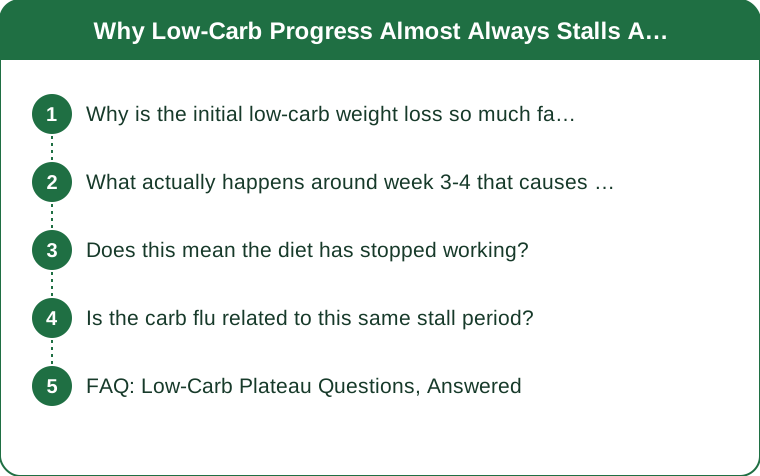
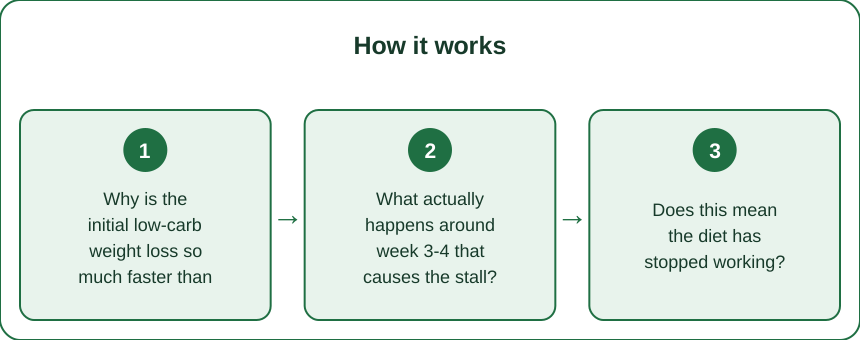
Why is the initial low-carb weight loss so much faster than what follows?
Carbohydrate is stored in the body bound to water — roughly 3-4 grams of water per gram of stored glycogen. Cutting carbs depletes glycogen stores quickly, releasing that bound water as measurable weight loss within the first 1-2 weeks that isn’t fat loss at all, just water shifting out of storage.
What actually happens around week 3-4 that causes the stall?
Once glycogen stores and their bound water reach a new lower equilibrium, the rapid, water-driven weight loss naturally stops — what continues afterward is the slower, more modest pace of actual fat loss, which was always going to look dramatically slower by comparison to the first two weeks.

Does this mean the diet has stopped working?
No — it means the easy, non-fat-loss portion of the process has run its course, and the results going forward reflect genuine fat loss rate, which is inherently slower and less dramatic than water-weight loss regardless of diet approach. Expecting week 1 pace to continue indefinitely is the actual mismatch, not a failure of the diet.
Is the carb flu related to this same stall period?
It’s a related but separate phenomenon — the carb flu (fatigue, headaches, irritability) typically resolves within the first 1-2 weeks as the body adapts to lower carbohydrate availability, usually before the weight stall becomes noticeable. Both are part of the same broader adaptation window, just on different timelines.
FAQ: Low-Carb Plateau Questions, Answered
How long does the typical low-carb stall last?
Most people see continued, slower progress resume within 1-3 weeks once the water-weight adjustment settles — a longer stall is worth reviewing overall calorie intake and activity level rather than assuming it will resolve on its own indefinitely.
Should you change your carb intake further during a stall?
Not immediately — the stall is often a normal transition phase, not a signal to cut carbs further. Reassess after several weeks of genuinely stalled progress, not after the first flat week.
Does exercise intensity need to change during this stall period?
Workout performance often dips slightly during the initial carb-adaptation window regardless of the scale — this typically improves as the body becomes more efficient using fat for fuel over the following weeks.
TL;DR:
- Rapid early low-carb loss is mostly water bound to glycogen, not fat — it was never going to continue at that pace
- The week 3-4 stall marks water weight reaching a new equilibrium, not the diet failing
- Real fat loss continues afterward, just at a slower, less dramatic rate than week one
- Give the stall 1-3 weeks before changing anything — most people see progress resume on its own
If the scale stalls right on schedule, that’s actually a sign the process is working as expected, not a reason to abandon it early.
Keep Reading
This article is for general informational purposes only and is not medical advice. Always consult a qualified health professional for guidance specific to you.