Why You Crash Mid-Workout on Low Carb — and the 3 Fixes That Actually Help
Quick Answer: Mid-workout crashes on low carb usually come from insufficient pre-workout glycogen for high-intensity efforts. Timing a small carb intake 60-90 minutes before training, allowing 2-3 weeks for fat-adaptation, or reserving low-carb days for lower-intensity training all meaningfully reduce the crash.
You’ve been eating low-carb for weeks and it’s going fine — until you hit the gym and your legs just stop cooperating around minute twenty. This is one of the most common, and most fixable, low-carb training complaints.

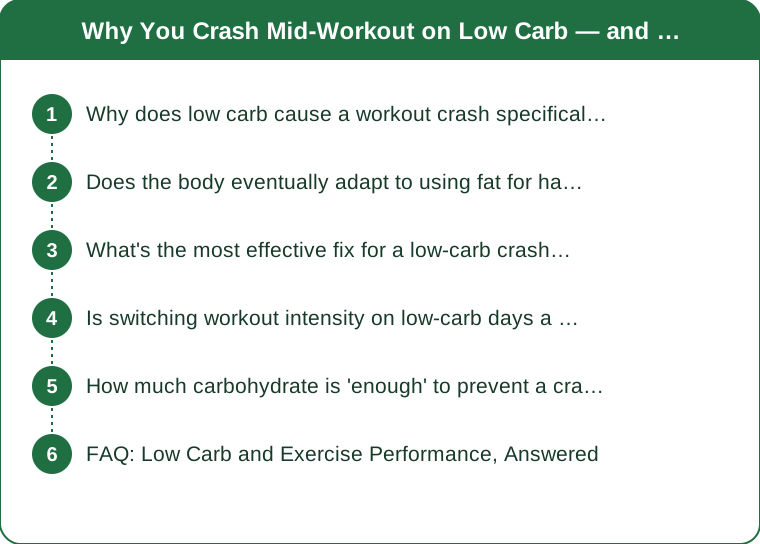
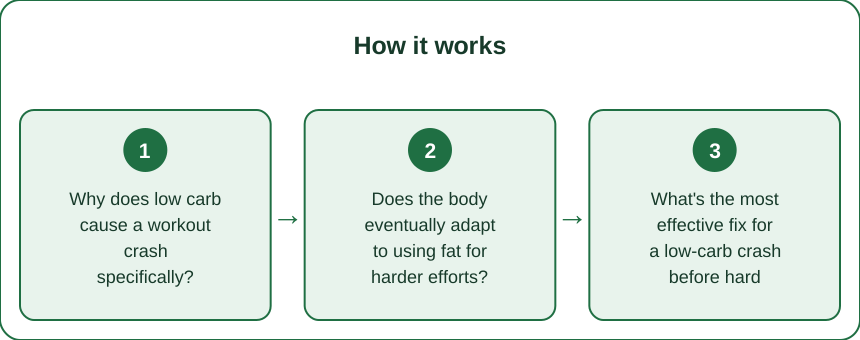
Why does low carb cause a workout crash specifically?
High-intensity exercise relies heavily on glycogen (stored carbohydrate) for fast energy, and low-carb eating depletes those stores without fully replacing them. Fat can fuel lower-intensity, longer-duration effort reasonably well, but once intensity crosses into anaerobic territory — sprints, heavy sets, HIIT — the body needs glycogen it may not have on hand, and that’s exactly where the wall shows up.
Does the body eventually adapt to using fat for harder efforts?
Partially, and it takes longer than most people expect. Fat-adaptation for exercise performance typically takes 2-4 weeks of consistent low-carb eating before performance at moderate intensities recovers close to baseline. However, most research still shows a measurable gap remains at the very highest intensities even after full adaptation — the body gets better at using fat, but doesn’t fully replace glycogen’s advantage for max-effort work.
What’s the most effective fix for a low-carb crash before hard workouts?
A small, targeted carb intake 60-90 minutes before high-intensity training — sometimes called carb timing or targeted keto — is the most consistently effective fix in the research. This doesn’t require abandoning a low-carb diet overall; it means concentrating what carbs you do eat around your hardest training sessions rather than spreading them evenly through the day.

Is switching workout intensity on low-carb days a valid alternative?
Yes, and it’s simpler for many people to execute consistently. Matching training intensity to available fuel — lower-intensity steady cardio or moderate strength work on strict low-carb days, saving max-effort or HIIT sessions for days with slightly more carbohydrate — sidesteps the mismatch entirely rather than trying to force high-intensity output on a depleted system.
How much carbohydrate is ‘enough’ to prevent a crash without abandoning the diet?
Research on targeted approaches generally uses 20-40 grams of easily digestible carbohydrate in the pre-workout window for this purpose — enough to top off immediate glycogen availability without derailing a broader low-carb eating pattern for the rest of the day.
FAQ: Low Carb and Exercise Performance, Answered
How long does it take to adapt to low-carb training?
Most people see meaningful improvement in moderate-intensity performance within 2-4 weeks; a full gap-close for max-intensity efforts may never fully happen for everyone.
Should you eat carbs after a workout too, even on low-carb?
Some approaches allow a small post-workout carb window to support recovery without significantly affecting overall daily carb totals — this is a personal preference call within a low-carb framework, not a rule.
Is it safe to do HIIT on a strict low-carb diet?
Generally yes for most healthy adults, but expect reduced peak output initially; if you have any underlying metabolic condition, check with a doctor before combining strict low-carb eating with high-intensity training.
TL;DR:
- Crashes happen because high-intensity exercise needs glycogen fat can’t fully replace
- Fat-adaptation takes 2-4 weeks and still leaves a gap at max intensity for most people
- Timing 20-40g of carbs 60-90 minutes pre-workout is the most effective fix
- Alternatively, match training intensity to the day’s carb availability
This is general information, not medical advice. The crash isn’t a sign low-carb ‘doesn’t work’ for you — it’s a fuel-timing mismatch with a specific, testable fix.
Keep Reading
This article is for general informational purposes only and is not medical advice. Always consult a qualified health professional for guidance specific to you.