Can You Actually Run Long Distances on a Low-Carb Diet?
Quick Answer: It’s possible but requires a real adaptation period (often 4-6+ weeks) for your body to shift toward fat oxidation, and performance in shorter, high-intensity efforts typically suffers more than steady, lower-intensity distance running. Many competitive distance runners still periodize carbs around key sessions rather than staying low-carb year-round.
The short answer is yes, your body can run long distances fueled mostly by fat — but the transition period and the type of running you do both matter a lot for how well it actually works.

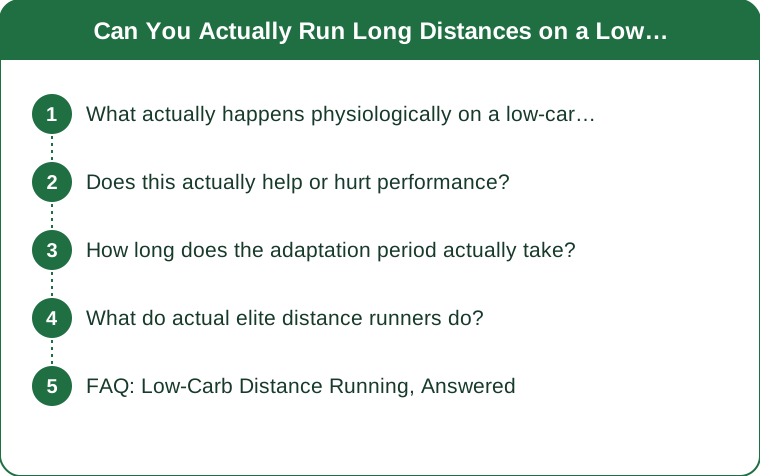
What actually happens physiologically on a low-carb diet for running?
After several weeks of consistently low carb intake, the body upregulates fat oxidation enzymes and becomes more efficient at using fat as fuel, sparing the limited glycogen stores that normally get depleted during long runs. This shift is often called ‘fat adaptation’ or ‘keto adaptation’ depending on how low the carbs go.
Does this actually help or hurt performance?
It depends heavily on intensity and duration. For long, steady-state runs (think easy-to-moderate long runs), fat adaptation can genuinely help by delaying glycogen depletion. For anything requiring higher intensity — race pace surges, hill repeats, a hard finishing kick — carbohydrate remains the more efficient fuel, and low-carb athletes often see a real drop in top-end performance.

How long does the adaptation period actually take?
Most research and coaching experience points to 4-6 weeks minimum before performance stops declining and starts to stabilize on a low-carb approach — the first 1-2 weeks in particular tend to feel notably worse (sometimes called the ‘low-carb flu’) before things improve.
What do actual elite distance runners do?
Many high-level distance runners use a periodized approach rather than staying low-carb permanently — training some easy sessions in a lower-carb state to build fat adaptation, while still fueling harder key workouts and races with carbohydrates. This ‘train low, race high’ pattern tries to capture benefits from both approaches.
FAQ: Low-Carb Distance Running, Answered
Will I lose speed if I switch to low-carb for running?
Most people see reduced high-intensity performance during and shortly after the adaptation period; steady-state endurance performance is more likely to hold up or even improve for some runners.
Do I need to fully avoid carbs to get fat-adaptation benefits?
No — moderate carb restriction (not full ketogenic-level) still shifts fuel use toward fat to some degree, without as steep a performance dip during adaptation.
Is low-carb running safe for training for a marathon or longer?
It can work for many runners, but the adaptation period should not overlap with peak training weeks or race week — plan the low-carb transition well before your key training block, and consult a sports dietitian if you have any underlying health conditions.
TL;DR:
- Fat adaptation is real and can happen with 4-6+ weeks of consistent low-carb eating
- Steady, lower-intensity distance running tolerates it better than high-intensity efforts
- Many elite runners periodize rather than staying low-carb permanently
- Don’t start the adaptation transition during peak training or race week
This is general information, not medical or sports-nutrition advice — a sports dietitian can help tailor this to your specific training load.
Keep Reading
This article is for general informational purposes only and is not medical advice. Always consult a qualified health professional for guidance specific to you.