Does Going Low-Carb Actually Hurt Your Workout Performance?
Quick Answer: Low-carb diets tend to modestly reduce performance in high-intensity, glycolytic exercise (sprints, heavy lifting, HIIT) because those efforts rely heavily on fast-access glycogen, but have little to no negative effect — and sometimes a benefit — on longer, steady-state aerobic exercise once fully fat-adapted.
The honest answer to ‘will low-carb hurt my workouts’ depends entirely on what kind of workouts you’re actually doing.

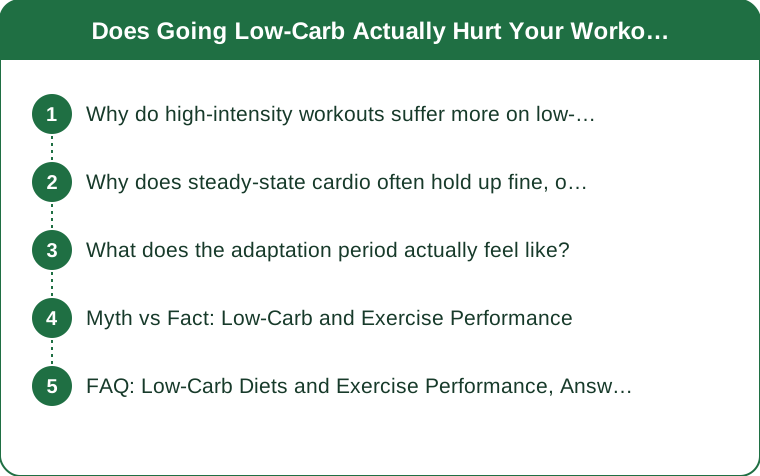
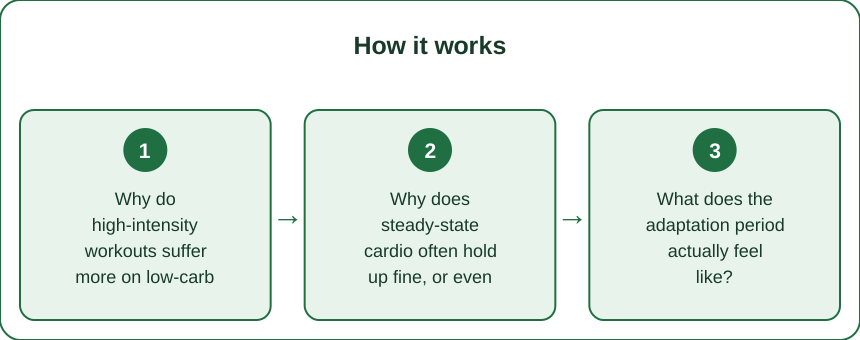
Why do high-intensity workouts suffer more on low-carb specifically?
Sprinting, heavy lifting, and HIIT rely on the glycolytic energy system, which draws primarily from stored muscle glycogen for fast energy. Low-carb intake keeps glycogen stores chronically lower, which directly limits the fuel available for this specific type of effort — this isn’t a mindset issue, it’s a fuel-availability issue.
Why does steady-state cardio often hold up fine, or even improve?
Longer, lower-intensity aerobic exercise relies more on fat oxidation, a fuel source low-carb diets make more available and, over time with adaptation, more efficiently used. Endurance athletes who fully fat-adapt (a process that takes 2-4 weeks minimum) sometimes report steady, if not improved, performance in this specific exercise type.

What does the adaptation period actually feel like?
The first 1-2 weeks of a low-carb diet often bring genuinely reduced performance across all exercise types — sometimes called the ‘low-carb flu’ — as your body hasn’t yet upregulated fat-burning enzymes. Performance for aerobic exercise typically recovers or improves after this window; high-intensity performance often doesn’t fully recover to prior levels even after adaptation.
Myth vs Fact: Low-Carb and Exercise Performance
Myth: Low-carb always hurts exercise performance. Fact: The effect depends heavily on exercise type — endurance athletes often adapt well, while strength and HIIT athletes see more persistent reduction.
Myth: The performance dip is purely psychological or willpower-related. Fact: It has a real physiological basis in reduced glycogen availability for glycolytic exercise — it’s not just feeling less motivated.
Myth: You can’t do any high-intensity training on a low-carb diet. Fact: Strategic carb timing around high-intensity sessions (targeted or cyclical approaches) lets many people maintain both a lower-carb baseline and reasonable high-intensity performance.
FAQ: Low-Carb Diets and Exercise Performance, Answered
If I do both strength training and cardio, should I still go low-carb?
A cyclical or targeted approach — higher carbs around strength sessions, lower on rest or cardio days — often balances both goals better than a strict flat low-carb approach.
How long should I give my body to adapt before judging performance?
At least 2-4 weeks of consistent low-carb intake before drawing conclusions — early performance dips are common and often temporary for aerobic exercise specifically.
Does this mean athletes should avoid low-carb diets entirely?
Not necessarily — it depends on their specific sport’s energy demands; a marathoner and a powerlifter face genuinely different tradeoffs from the same dietary approach.
TL;DR:
- High-intensity, glycolytic exercise (sprints, HIIT, heavy lifting) suffers most on low-carb
- Steady-state aerobic exercise often holds up or improves once fat-adapted
- The first 1-2 weeks bring a real, physiological performance dip for most people
- Targeted or cyclical carb timing lets many people balance both training types
The question isn’t whether low-carb hurts performance — it’s which performance you’re actually optimizing for.
Keep Reading
This article is for general informational purposes only and is not medical advice. Always consult a qualified health professional for guidance specific to you.